Painted 28mm resin 3D printed model of World War II Soviet medic team.
This release sees the introduction the Winter War Soviets to our range, adding infantry and crew in Winter uniforms to many Soviet options including regular squads, HQ units, support and the Artillery.
Additionally, we have also introduced two totally new vehicles to our range – the NKL-16 Aerosan and the multi-turret monster that is the T-28.
As usual with a new army, we have added a platoon bundle for you and also updated the Soviet Army Builder to include the new Winter War troops and vehicles.
As always, here’s a little background on the various new units…..
The T-28 was an infantry support tank developed by the Soviet’s during the 1930s. A long tank, featuring multiple turrets, it appears to be strongly influenced by the British A1E1 Independent (and indeed may have been based on stolen plans……). Primary armament was a 76mm gun in a fully traversing main turret, and four machine guns split between the main turret and a pair of secondary turrets.
Initially deployed in 1939 during the Winter War, the T-28 was shown to be slow, heavy and inadequately armoured. However, improvements were rapidly made and a new, up-armoured version led the way through the Finnish Mannerheim Line.
Over 500 were built and captured examples used by Finland were used against their former owners.
The NKL-16 was an aerosan used by the Soviet army during WWII. Built of plywood, it was very lightweight and could reach speeds of 30mph across snow. The NKL-16 was later developed into the armoured NKl-26 which was armed with a machine gun in a ring mount.
Further updates are also available via our Facebook page.
We hope that you found this little bit of background history and that soon our models will be reinforcing your Soviet armies!
This release sees the introduction of new defensive structures for the British. As with our other models, these are all based on original examples in the UK. Expanding a little from just the usual pillboxes, these also include a minefield control tower and coastal gun emplacement.
These will also be available soon as files for printing at home via our STL page.
As always, here’s a little background on the various new models…..
Many pillboxes had a dedicated light AA mount into the design (such as the Type 23 and Type 27) and others were adapted during or after construction with LAA mounts. This example is a modified Type 22 design with a protected entrance and a LAA on the roof.
Along the East coast of England, there were a number of emplacements that were sited for defending against a seaborne invasion. These could be armed with a range of weaponry, usually older, large calibre guns (often ex-naval), but in some desperate attempts to increase the appearance of firepower, telegraph poles were used if sufficient guns were not available! This example from the North East coast was equipped with a 4” naval gun.
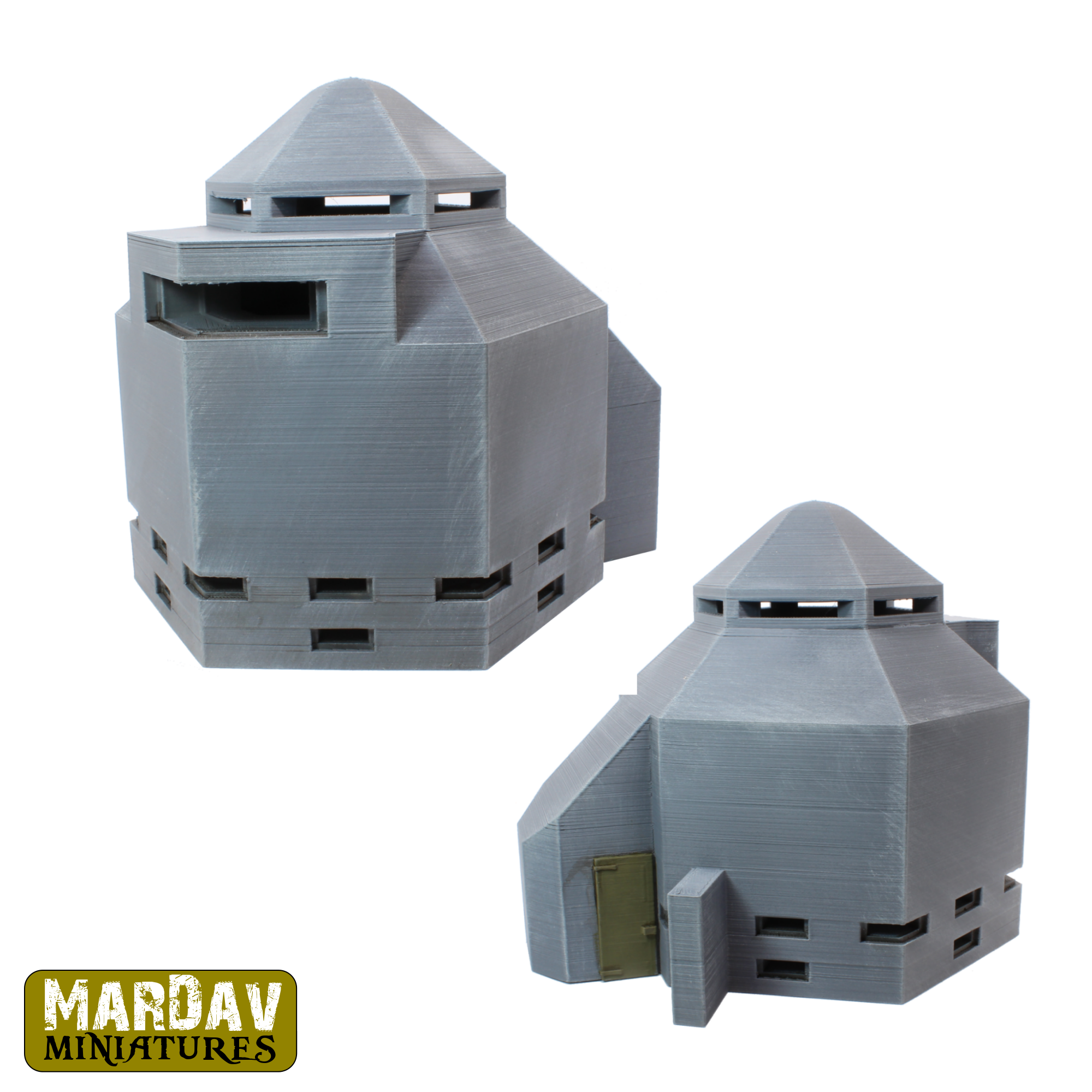
The Mowlem Drum pillbox was an unusual design produced by J Mowlem Builders and found on GHQ Line B in Surrey. Essentially a thick walled Type 24, the “Surrey Drum” was simply formed due to using a curved shuttering rather than building a brick wall and pouring concrete within it. This created a larger, round pillbox.
The coast of mainland Britain is penetrated by dozens of rivers and many more smaller inlets. As it was thought that German invasion barges could make their way up these and land troops behind the “coastal crust” additional defences were added around the mouths of the later estuaries including minefields, defensive booms and buoys. At a couple of locations, the defences were extensive enough that they required their own minefield control tower. This example is based on the control tower at Burnham-on-Crouch
Further updates are also available via our Facebook page.
We hope that you found this little bit of background history and that soon our models will be reinforcing your British Home Front!
This release sees the introduction of new tanks for the Germans. We round out their range to include fully armoured SPGs, assault guns, heavy and medium tanks and tank destroyers. July 1943 saw the start of the largest tank battle ever seen (probably) – Kursk. These tanks represent a selection of those fielded by the Germans during the battle.
As always, here’s a little background on the various new units…..
The “Stummel” was a variation of the Sd.Kfz 251 halftrack introduced by the German Army in 1942. There was a need for mobile light artillery support that could maintain pace with other vehicles. Unlike some other SPGs, the Stummel carried its own ammunition and was a self contained artillery piece. Mounting the same 75mm L/24 low velocity gun as some StuG III variants, it was a useful close support vehicle.
The Sturmgeschütz III (or StuG III) was a German assault gun of WWII. It was the most widely produced German fully tracked AFV of the war, and the second most numerous German AFV in total behind the SdKfz 251. Originally designed as an infantry support weapon, it was built on a modified PzIII chassis. It mounted a limited traverse gun in an armoured superstructure.
Variants of the StuG III were equipped with different guns. Initially, as they fulfilled the infantry support role, these were low velocity howitzers. However, later variants also mounted more powerful anti-tank guns. Later models were also equipped with an MG34 mounted near a hatch, sometimes fitted with a shield.
The StuG III was a popular tank with the German High Command. Primarily as it was around cheaper to build than a PzIII due to the lack of turret and simplified design. They were also popular with their crews. This was primarily due to their low silhouette making them difficult to spot and they were generally reliable.
Over 11,300 variants were produced in total and many were exported to other nations such as Hungary, Italy and Finland. They continued to see service for some years after the war as well.
The Panzer IV was a German medium tank of WWII and their most produced tank during the war. Designed in the 1930s and introduced in 1939, it saw service throughout all German theatres of operation. The PZIV was the only German tank in production continuously during the war.
Early marks of the PzIV were armed with the 75mm L/24 low velocity howitzer as found on early StuG III variants and the Stummel. Later marks received the more powerful 75mm L/43 and finally 75mm L/48 anti-tank guns which allowed them to effectively engage Allied tanks.
Two of the most notable and visible features on later PzIV tanks is the addition of Zimmerit paste to stop the use of magnetic explosives, and the “Schurzen” side skirts mounted on the turret and hull to protect against shaped charge weapons such as the PIAT.
The PzIV chassis also formed the basis of many other vehicles including various Flak panzers such as the Wirbelwind, Mobelwagon and Ostwind, tank destroyers like the Jagdpanzer IV and assault vehicles such as the StuG IV and Sturmpanzer IV.
Over 8500 were built in total and saw service with various countries after the war as training vehicles, static defence or even as “main battle tanks”!
The “Hummel” (Bumblebee) was a German SPG produced in 1943 and used for the remainder of World War II. Operation Barbarossa had shown that existing SPGs were not always adequate and so a new type was designed. Mounting a 15cm sFH howitzer on a heavily modified PzIV chassis, with an open superstructure, it was an effective support vehicle, though lack of stowage meant it required a separate ammunition carrier. The same modified PzIV chassis was used for the Nashorn tank destroyer.
The “Nashorn” (Rhinoceros) was a lightly armoured and heavily armed German tank destroyer of WWII. Based on the same modified PzIV chassis as the Hummel, it also had an open crew compartment but mounted a 8.8cm PaK 43 anti-tank gun rather than a howitzer. It first saw combat during the Battle of Kursk where its high profile and powerful gun allowed it to dominate the open steppe at range, and negated much of the disadvantage of the thin armour and open crew deck.
The Nashorn was later replaced by fully enclosed and more heavily armoured tank destroyers such as the Jagdpanzer IV but it remained in service until the end of the war.
The Sturmpanzer IV (or “Brummbär” as known by Allied intelligence) was a heavy assault gun used by Germany during WWII. Based on the chassis of a PzIV tank, it replaced the upper hull and turret with a thickly armoured (100mm at the front) superstructure and mounted a newly designed 15cm Sturmhaubitze.
The Sturmpanzer IV was introduced in April 1943 and its first major test in combat was the Battle of Kursk. It performed acceptably, but the overall weight was too much for the chassis and it suffered frequent breakdowns. A series of revisions were made to the overall design of the assault howitzer and the weight brought down by around 800kgs. As the first versions did not have adequate ventilation in the crew compartment, leading to a build of propellant fumes, A “quality of life” improvement was also made – an extractor fan was fitted!
The Panther was a German medium tank of WWII initially developed in response to the T-34 and its effective sloped armour. Originally designed to replace the aging PzIII and PzIV tanks, it fought alongside them until the end of the war.
Armed with the excellent 75mm KwK 42 L/70 and featuring heavily sloped and thick frontal armour, the Panther is often called “the best tank of WWII”. However, it had plenty of disadvantages – the increased frontal armour was at the expense of thinner side armour to keep the weight down; it was a complex machine and often ran into mechanical issues causing many to be lost to breakdown rather than enemy action and it was still heavy which caused logistical issues.
It was first deployed en-masse during the Battle of Kursk, though it was riddled with mechanical problems and this led to high losses. Lessons from summer 1943 led to a series of changes in the design and by 1944 many issues had been ironed out.
The Tiger I was a German heavy tank of WWII and possibly one of the most famous (and most mythologised) tanks ever built. Developed at the start of WWII, it was first deployed in 1942 in Africa and on the Eastern Front. The Tiger I was the first German tank to mount an 88mm anti-tank gun and it soon earned a fearsome reputation as very few Allied armoured vehicles could withstand a hit from a Tiger I.
While it had exceptionally thick (100mm+) frontal armour, it was simply vertical plates with little to no slope unlike that of the T-34 or Panther tanks. It was also overly complicated and its overlapping road wheel configuration caused issues in mud and snow. The weight and width of the Tiger also made it difficult to transport to a combat zone.
However, it was a successful tank and as redesigns dealt with various issues, its reliability increased until it equalled or exceeded that of other German AFVs.
Around 1350 were built in total.
Further updates are also available via our Facebook page.
We hope that you found this little bit of background history and that soon our models will be reinforcing your German armies!
This release sees the introduction of new tanks for the Soviets, as well as a couple of new updates to existing vehicles. July 1943 saw the start of the largest tank battle ever seen (probably) – Kursk. These tanks represent a selection of those fielded by the Soviets during the battle.
As always, here’s a little background on the various new units…..
The T-70 was a Soviet light tank introduced in 1942 and used throughout the rest of WWII. Designed as an improvement of the previous T-60, it had a more powerful 45mm main gun, better cross country capabilities and slightly thicker armour. The T-70 still suffered from the drawbacks of relatively thin armour and a weak gun when placed next to even contemporary medium tanks, but it could be produced in large numbers by factories unable to manufacture larger tanks.
Its finest moment was when a lone T70, commanded by Sergeant Alexander Pegov, ambushed a column of 18 Germans tanks and knocked out two Panthers, immobilizing the column.
The T-34 was a medium tank used by the Soviets during WWII. Initially introduced in 1940, it was designed to replace the current range of light and medium tanks in the Soviet army, many of which were obsolete. Armed with a 76mm gun and featuring sloping armour, the T-34 on paper was easily a match for any other medium of the time, and a good deal better than many of them. Combined with a low cost and rapid production time, the T-34 became the second most produced tank of all time (behind its successor, the T54/55 series). However, in reality, the combination of poor visibility and lack of good leadership and training, meant that in the field the T-34 was often outclassed by numerically inferior Axis forces.
The KV-1 was the first of a range of Soviet tanks of WWII named after the Soviet Defence Commissar (Kliment Voroshilov). Introduced in 1939, the KV series really gained notoriety with the German Army during Operation Barbarossa when it was found that their heavy armour rendered them practically immune to the invading PzIII and PzIV tanks armed with 37mm and short barrelled 75mm guns. In fact, at the time, a KV tank was virtually invulnerable to anything short of a FlaK 88 or point blank artillery fire.
However, they also had shortcomings of their own – the heavy armour made them slow and sluggish; the main gun was no better than that mounted on a T-34/76; at 45 tons they really were too heavy for the Soviet transport infrastructure once they were disembarked from trains.
Over 5000 KV-1 tanks were produced and ultimately they served through until the end of the war.
The KV-2 was a development of the KV-1 heavy tank introduced in 1940 and in service until 1945. Essentially a KV-1 with a new turret, the KV-2 had a very large boxy turret mounting a devastating 152mm howitzer. Developed as a breakthrough tank, the new turret added an additional 7 tons to an already incredibly heavy tank and massively increased its height and silhouette.
The increased weight also added further drawbacks – the top speed and ability to cross rough ground was drastically reduced, and the weight of the huge turret meant it could only transverse when level.
Overall, its lacklustre performance and the development of better breakthrough assault vehicles led to only 200 KV2 tanks being produced.
The SU-122 was an anti tank platform designed around the T-34 chassis and featuring the A-19 122mm gun used by the IS-2. Designed as a breakthrough gun, the AT capabilities of the A-19 were also excellent, and easily capable of destroying a Tiger I at 1000m. Produced between winter 1942 and summer 1943, the SU-122 saw service for the rest of the war.
The SU-152 was an anti tank platform designed around the KV-1 chassis and featuring a 152mm gun howitzer. Unlike the SU-122, the SU-152 was more effective as a howitzer than an AT gun. However, the sheer power of the shell could still blow the turret from a King Tiger, earning the 152 the nickname of “Beastkiller”. Unlike the KV-1, the SU-122 had a much larger fighting compartment due to the casement fitted gun, but suffered from a lack of traverse.
Further updates are also available via our Facebook page.
We hope that you found this little bit of background history and that soon our models will be reinforcing your Soviet armies – Ura!
This release sees the introduction of a range of new and replacement units for the Japanese in what is one of our biggest releases yet!
First up are the additions to the HQ units – models to represent a Senior officer or a Kempei, both along with a second to act as an aide. There is also a more combat orientated officer team termed the “Banzai officer” for those who want their commanders to look a little more pro-active!
Next, the SNLF make an appearance with both an SMG squad and a rifle squad (with LMG) bulking out the infantry selections for the Japanese.
Finally, support arrives in the form of some Big Guns! Single and twin mounted light AA options, a light AT gun and a pair of howitzers (light and heavy) round out the available options.
As for replacements, the standard rifle squad, officer, light mortar and MMG teams all get new models, designed as the rest of range are by the talented designers of Studio Grozny.
As always, here’s a little background on the various new units…..
The Kempeitai were the Japanese military police from 1881-1945. However, due to their additional roles covering counter-intelligence, espionage and secret police activities, the Kempeitai were more akin to the NKVD or Gestapo than the Feldgendarmerie or Royal Military Police.
Charged with the organisation and running of the Japanese internment and POW camps, the Kempeitai’s reputation in WWII was one of cruelty and brutality as they enforced strict rules with summary executions and massacres against both their charges and civilians. They were also responsible for the procurement of human subjects for Unit 731 and the “comfort women”.
The Special Naval Landing Forces (SNLF) were Japanese naval infantry units during WWII. They were not dedicated marines, but were instead formed of members of a ship’s crew who had infantry training in addition to their naval basic training. As with regular IJA soldiers they were trained in the use of infantry tactics, rifles, SMGs, mortars, machine guns and various other small arms and heavy weapons.
The Type 96 25mm AA gun was a Japanese variant of the Hotchkiss 25mm and was used during WWII. A dual purpose weapon, designed for AA duty and as a light anti-vehicle weapon, it was most frequently deployed for AA cover in a single, dual or triple mount. It was the standard medium AA weapon used by the Japanese navy, though was vastly inferior to similar weapons in use by the navies of other nations due to its slow reload (manually changing a 15 round magazine), elevation and traverse.
The Type 1 37mm was a light anti-tank gun used by the Japanese during WWII. Essentially a modified Type 94 37mm AT gun, it suffered many of the drawbacks of its predecessor, most notably a lack of penetration against heavier US tanks such as the M4 Sherman. However, it had a low profile and was effective as an ambush weapon. It was also used as the main armament in light tanks such as the Type 2 Ke-To and Ka-Mi.
The Type 98 20mm AA “machine cannon” was a light AA weapon used by the Japanese during WWII. Introduced in 1938, it was the most common light AA gun in service with the Japanese Army. It was an effective weapon and generally considered to be well made and maneuverable. It could be deployed in around 3 minutes, but was also usable (inaccurately) from the carriage. The high rate of fire combined with an AP round also saw it used as an emergency anti-tank weapon at times.
The Type 41 75mm light howitzer was a Japanese artillery piece of the early-mid 20th century. Built as a licensed copy of the Krupp M1908, it saw service from 1908 to 1945. Due to how it was fielded, the crew could number as high as thirteen with the majority being gunners and ammunition carriers. It was also designed to break down into manageable components that could be carried by packhorse.
The Type 4 150mm howitzer was a howitzer of WWI vintage used by the Japanese throughout WWII. Despite being outdated by the late 1930s, lack of a suitable replacement in sufficient numbers meant it continued in frontline service until 1945. While it had some good points – it was relatively light for its size which made transportation over rough ground easier, and it had excellent elevation; it was also considerably underpowered compared to contemporary howitzers and its crew were out ranged and out gunned when facing Allied artillery.
Further updates are also available via our Facebook page.
Hopefully you found this bit of background history interesting and our models will be reinforcing your Japanese armies.
This release sees the introduction of a range of landscaping terrain pieces including modular hills (one with an option to have a cliff mounted bunker!), an assortment of rocky outcrops, a river with fords and a length of bocage hedgerow.
As always, here’s a little background on the various new models…
Whether sand dunes in the desert, gently rolling rises or the craggy beginnings of a mountain range; hills are a common feature of battlefields and the landscape in general. As a strategic viewing point or place to site big guns, no wargaming terrain collection is complete without a few hills.
These modular hills can be assembled in a variety of ways allowing for placement on the edges and corners of a table, or as a single larger piece. Each is comprised of 6 pieces and is supplied with a series of clips to ensure they stay together on the table
Each set of 6 differs slightly, as below:
1 – mostly rock faces but with a slope at one end. The sunken bunker can also be added to this hill.
2 – approximately half rocky cliff faces and half sloping
3 – mostly sloping with a small rocky area at one end
They may be exposed and wind-scored sandstone cliffs in a sea of sand, or the ancient weathered remains of a long dormant volcano, or anywhere in between; but large rocky outcrops are certainly useful pieces of terrain! Those assorted rock pieces are a must for any terrain set and will add another level of detail to a table. The various designs allow for either complete line of sight blocking escarpments or cover providing groups of boulders.
Across the world from jungles of the Pacific to the fields of Normandy to Western Desert (ok….maybe not always the desert!), rivers, whether broad or narrow, shallow or deep have provided an obstacle to armies for centuries. This set represents a relatively narrow and shallow river that can be forded. With a length of approximately 145cm (at 28mm), there are the following pieces in this set:
The bocage hedgerow of Normandy posed a great problem to the liberating Allied forces and a wonderful opportunity for defence to the occupying Germans. Formed of earth packed stone walls with dense bushes and hedges growing from them (often centuries old), the lanes between the hedgerows were hidden from each other and opposing forces could be within a few metres of each other and not realise! Additionally, the tightly packed undergrowth and narrow lanes made moving vehicles difficult and perilous as hidden ambushes could be set up almost anywhere.
This set comprises enough pieces to build a hedge of approximately 120cm in length (at 28mm) and also includes a gateway and area of removed hedge to represent a passage cleared by a Cullen cutter, bulldozer or similar. The pieces are supplied as bare 3D prints, the finished photos is to show what the pieces can look like once finished with a suitable material (rubberised horsehair and flock in this case).
The full set contains:
6 x straight
1 x gateway
1 x bulldozed section
2 x ends
2 x 45 degree angles
1 x Y section
Further updates are also available via our Facebook page.
We hope that soon our new terrain will be adorning your battlefield!
This release sees the introduction of a range of light vehicles for the Axis, ranging from motorcycle equipped troops to staff cars to an artillery tractor and more!
As always, here’s a little background on the various new units…..
Kradschutzen truppen (Motorcycle troops) were highly mobile infantry units used by the German Army during WWII. Often attached to Panzer divisions, they were lightly armed and used as reconnaissance and mobile assault units. A variety of bikes were used, with the main type being the BMW R12.
The VW Type 82 Kubelwagon (or “bucket-car”) was the most common light utility vehicle of the German Army during WWII with over 50,000 being manufactured. Despite being only two-wheel drive, its performance surprised even its own developers during trials as it was capable of exceptional cross-country performance.
Many variants were made including the Schwimmwagen, a commander’s car with a Beetle body, a radio car and a light support version with an MMG on a pintle mount. Due to lack of fuel, there was even a coal powered model designed!
The Horch 108 field car was an off-road vehicle developed in the 1930s and used by the German army during WWII. It was a rugged and reliable machine, capable of towing a variety of light to medium guns and their crews. It was also used as a heavy staff car and also as a platform for other weapons such as the 2cm FlaK.
The Type 95 Kurogane (also known as “Yonki” or “Daruma”) was a light 4WD vehicle similar to the Kubelwagon. It was developed in the 1930s and used by the Japanese army during WWII. It was unique as it was the only completely Japanese designed car used by the army, as they generally used civilian cars. As it predates the Gaz and Willys jeeps, it was one of the first 4WD passenger vehicles in the world to enter mass production with over 4,500 being made.
While it was a small vehicle, it had excellent off road capabilities and was available in a variety of body types.
The Fiat 508 was an Italian civilian passenger car of the 1930s. There were many variants produced, including a Torpedo body style. This style was later adapted into the Coloniale variant that was used by the Italian military up to and including WWII.
The Type 1 Ho-Ki was a heavy artillery tractor that could also be used as an APC as it was capable of carrying over a dozen passengers. It was developed during WWII and used by the Japanese army. Usually unarmed, some were manufactured with mountings for machine guns, including the Type 92 HMG.
The Type 97 truck was a 1930s Japanese vehicle that was one of the most common lorries of the Japanese army during WWII. It was smaller than many contemporary transport trucks and was quite heavy for its size, but had good ground clearance to handle uneven island roads.
Further updates are also available via our Facebook page.
We hope that you found this little bit of background history and that soon our models will be reinforcing your various Axis armies – Vorauszahlung! or….. whatever else is appropriate for your army 😉
This release sees the introduction of a range of lights vehicles for the Soviets, ranging from motorcycle equipped troops to staff cars to an artillery tractor, and even a motorised tachanka!
As always, here’s a little background on the various new units…..
The GAZ-67 was a 4×4 jeep built and used by the Soviet Union during WWII. Originally based on the Willys Jeep, the GAZ-67 was just as rugged, reliable and useful as its American counterpart.
Over 92,000 were produced and saw service from 1943 through the war and into the 1950’s.
The GAZ-M1 was a Soviet passenger car of the 1930s that widely saw use as a staff car during WWII. The chassis was also used as the basis for the BA-20 armoured car.
This model is available as an open topped or hardtop variant.
The Tachanka was originally developed during WWI as a mobile machine gun platform. While their use continued through the interwar years and even into WWII, they were also updated to create more of a modern “technical” style vehicle. This included taking the basic concept and replacing the horse drawn cart with a jeep, thus creating a smaller, more survivable vehicle that was faster and less likely to get stuck in rough terrain.
The STZ-5 was an artillery tractor produced and used by the Soviet Union during WWII. Smaller than the Komintern and similar tractors, it was capable of carrying 1.5t on its rear bed, or of towing up to 8t. It has excellent reliability though poor power. Despite narrow tracks and a relatively high ground pressure, it also had good country capabilities.
A few STZ-5 were also adapted to carry the BM-13-16 rocket launcher; a weapon system more commonly associated with the ZIS truck based Katyusha vehicles.
During WWII, the Soviet Union used motorcycle troops as forward recon units for armored columns, as well as for capture of strategic points such as bridges. The most common motorbike, the IMZ-Ural M-72, was a direct copy of the German BMW R-71 and was a heavy, but sturdy, machine.
In addition to single mounted troops, sometimes Soviet motorcycle formations were equipped with a sidecar combination, allowing 2 soldiers to be carried more easily by a single bike. Sometimes these were equipped with an MMG, but often were just normal SMG armed soldiers as with the rest of the unit.
Further updates are also available via our Facebook page.
We hope that you found this little bit of background history and that soon our models will be reinforcing your Soviet armies – Ura!
This little release is just something small to fill in a gap in our British range but also introduce something new. The 6 pdr was the most common anti-tank gun in the British army during WWI and was also produced by the US and used by the Soviet and US armies.
This model also marks another first for MarDav – increasing our stl file range beyond terrain and expanding into equipment.
This release expands our terrain range with an assortment of pieces suitable for European battlefields – a church, houses, ruins and more will add to any game.
As always, here’s a little info on the various new items…..
The centre of many rural communities, the church is often a sanctuary and place of reflection for the population during times of trouble and invasion. However, sometimes, such as at Oradour-sur-Glane, they are the site of bloodshed and massacre by invading forces.
Low, stucco rendered cottages with pantile roofs are a common feature in Southern Europe, particularly Italy, Sicily and Southern France. Spread out among the fields or grouped together in a small village, they were the site of many a firefight during WWII.
Stone cottages, either rendered or plain, with a variety of thatch, slate and shingle roofs are probably one of the most rural building types across Europe. From Normandy, to Italy, to Poland, small villages and settlements of buildings such as these are dotted across the landscape. Often comprising no more than a few houses, these were frequently important objectives as they may control access to a bridge, crossroads or even just because they made a good base of operations.
Timber buildings have long been a staple of rural life – quick and easy to erect, simple to repair and often not requiring additional materials compared to more sturdy structures, they are a staple of poorer communities. While present in Western Europe, they are more common in Eastern Europe and on the Eastern Front.
An ever present aspect of rural life is livestock. Unfortunately during conflict many of these are caught in the crossfire and add to general debris of war left behind.
This set consists of 4 cows – 1 standing, 1 lying down and 2 dead.
Further updates are also available via our Facebook page.